





Intro: Why COAs Matter
When you’re shopping for THCa flower, frosty buds and strong aromas are exciting. But if you want to know what’s really inside, you need more than looks. That’s where the COA, or Certificate of Analysis, comes in.
A COA is a lab report that shows you exactly what was tested in your flower. It’s not just about potency — it also confirms safety. Learning how to read one is the easiest way to make sure you’re getting clean, high-quality hemp. If you’re completely new to THCa, you may want to start with our THCa Flower Guide before diving into COAs.
What Is a COA?
A Certificate of Analysis (COA) is a third-party lab report that gives a full breakdown of what’s in a batch of hemp flowers.
Most THCa COAs include three main parts:
- Cannabinoid Profile – This section highlights the percentages of THCa, THC, CBD, and other hemp-derived compounds.
- Terpene Profile – Another group of hemp compounds that add flavor and aroma.
- Safety Results – These are the results of tests for pesticides, heavy metals, and other contaminants.
This simple sheet is your best tool for knowing if the flower you’re buying is worth your money.
Key Sections of a THCa Flower COA
Here’s a real Certificate of Analysis for Girl Scout Cookies (GSC) THCa Flower:
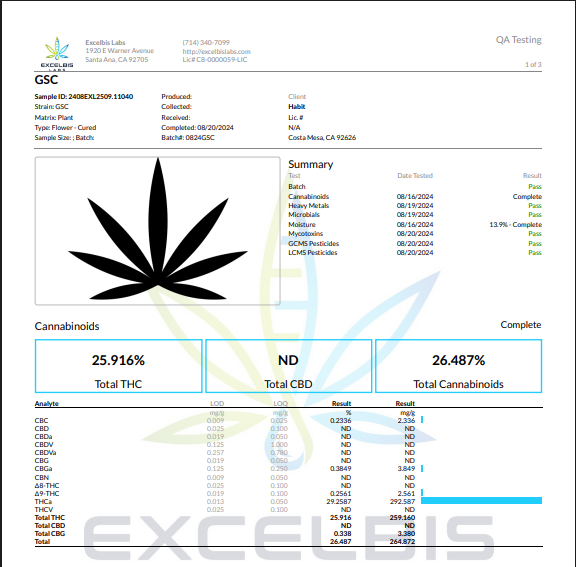
Now, let’s break it down step by step.
1. Cannabinoid Profile
In this report, you’ll see:
- Total THC: 22.320%
- Total CBD: 0.216%
- Total Cannabinoids: 22.823%
That means this batch is THCa-dominant with only trace amounts of CBD. The higher the percentage, the stronger the flower is considered.
2. Safety Testing
Look at the top right corner where it lists tests for foreign matter, heavy metals, pesticides, and mycotoxins. Every single one says “Pass.”
That’s important. A clean COA should always confirm that your flower is free of harmful contaminants.
3. Other Details
A good COA should always include:
- Batch number: Here it’s listed as 0225GSC.
- Date tested: 08/12/2025.
- Lab info: Excelbis Labs, a verified third-party lab.
These details prove that the COA matches the product you’re holding, not just a random old report.
4. Terpene Profile
Some labs also include terpenes on the report. Terpenes are what give strains their unique smells and flavors. For example:
- Limonene → citrusy
- Myrcene → earthy and herbal
- Caryophyllene → hints of spiciness
If there are terpenes listed in the COA, they can give you a preview of the overall taste and smell of the flower.
How to Read the Numbers
Seeing numbers on a page can feel overwhelming, but here’s a quick guide:
- THCa % – the main cannabinoid in raw hemp flowers.
- Total THC % – how much THC may be present after heating.
- CBD % – how much CBD is in the flower.
- Total Cannabinoids % – the full sum of everything combined.
👉 Tip: Don’t just chase the highest THCa number. Flavor, freshness, and safety are just as important.
Common Mistakes People Make
- Not checking the date. Always look for a recent test.
- Ignoring safety results. Clean results matter as much as potency.
- Skipping lab details. If the report doesn’t show the lab name, be cautious.
Why HabitCBD COAs Matter
At HabitCBD, every flower we sell — from GSC to other exotics — comes with a COA you can view yourself. We believe transparency is non-negotiable.
Wrap-Up: COAs Build Trust
At the end of the day, a frosty bud may look amazing, but the COA is what proves its quality. Learning how to read one helps you buy with confidence and avoid low-quality flower.
If you’re brand new to THCa, start with our THCa Flower Guide, then dive into COAs for a closer look at quality and safety.
At HabitCBD, every product comes backed by a lab report, so you know exactly what you’re getting. If you’re ready to buy THCa flower online, check out our exotics today and shop with confidence.
FAQs
What is a COA in simple terms?
It’s a lab test that shows what’s in your flower and confirms it’s safe.
How do I know if a COA is real?
Look for the lab’s name, date, and batch number. It should come from a third-party lab.
What’s the difference between THCa and THC on a COA?
THCa is the raw form in the flower. THC may appear after the flower is heated.
Do all COAs include terpenes?
Not always. Some labs test for terpenes, some only show cannabinoids and safety.
How often should flower be tested?
Every batch should have its own COA. That’s the only way to ensure accuracy.